
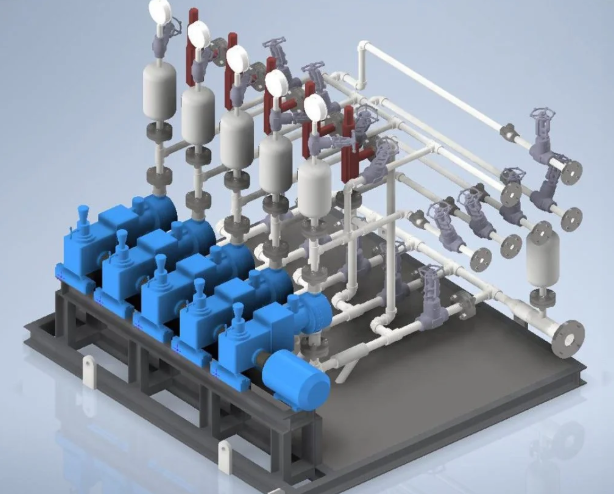

Chemical handling in process plants involves risks related to spills, exposure, incorrect dosing, pressure variations and equipment failure. These risks can increase when pumps, tanks, valves and injection components are installed as separate systems without sufficient coordination. A properly engineered package brings essential components together and allows the complete chemical handling process to be considered during design. The arrangement should account for chemical properties, required flow, operating pressure, containment, instrumentation and maintenance access. When these factors are addressed from the beginning, plants can improve operational control while reducing avoidable handling problems and supporting safer day-to-day process operations.
How a Chemical Dosing Skid Supports Safer Operations
A chemical dosing skid is a packaged system designed to handle and deliver chemicals to a process at a controlled rate. Depending on the application, it may incorporate storage or day tanks, dosing pumps, valves, piping, instruments, control panels and injection arrangements.
The main advantage of a packaged approach is that the components can be designed to work together rather than being selected independently. This allows engineers to consider the complete chemical transfer and dosing path before the equipment reaches the plant.
Key Components Within the Package
A typical arrangement may include:
- Chemical storage or day tanks
- Dosing pumps
- Suction and discharge piping
- Isolation and non-return valves
- Pressure relief arrangements
- Flow or pressure instruments
- Level monitoring
- Injection equipment
- Control systems
- Secondary containment where required
The exact configuration depends on the chemical, dosing rate, operating pressure and process requirements. Hazardous or corrosive chemicals may require additional containment and material compatibility measures.
Design Factors That Reduce Chemical Handling Risks
A chemical dosing skid should be designed around the properties of the chemical and the conditions under which it will operate. Treating all chemicals in the same way can create avoidable equipment and safety problems.
Chemical concentration, viscosity, density, temperature and corrosiveness should be established before materials and components are selected. The system should also account for the required dosing range rather than being designed only for the normal operating rate.
Pressure is another important consideration. Pumps, valves, piping and fittings must be rated for the expected operating and design conditions. Pressure relief provisions can help protect equipment if an unexpected restriction or valve condition causes pressure to increase.
Containment should also be considered wherever a leak could expose personnel or damage surrounding equipment. Suitable bunding, trays or other containment arrangements may be incorporated according to the chemical and site requirements.
A well-planned layout can further reduce risk by keeping chemical connections organised and providing clear access to valves and instruments. This makes routine inspection easier and can reduce the likelihood of incorrect operation during maintenance.
Improving Dosing Control and Injection Performance
You can place Chemical injection quills naturally as the focus of the next sentence:
Accurate chemical delivery requires more than selecting a pump with the required capacity. The entire path from the chemical source to the process stream should be considered. Injection quills help introduce the chemical into the process stream effectively, while the pump must provide sufficient flow and pressure and remain suitable for the chemical. Suction conditions should be stable so that the pump can fill consistently. Restrictions, excessive pipe lengths or unsuitable fittings can affect pump performance.
At the process connection, the chemical must enter the main stream in a controlled manner. Injection quills are commonly used for this purpose because they provide a defined point for introducing a chemical into a process pipeline.
Why Injection Arrangement Matters
The injection location can influence how quickly and uniformly the chemical mixes with the process fluid. If the injection point is poorly positioned, the chemical may remain concentrated in one part of the pipeline rather than being distributed effectively.
The quill should be selected according to the pipeline dimensions, process pressure, chemical characteristics and required injection arrangement. Material compatibility is particularly important when aggressive chemicals are involved.
The relationship between the dosing pump, injection point and downstream mixing conditions should also be considered. The pump supplies the chemical, while the injection arrangement introduces it into the process. Any downstream static mixing or turbulence should be assessed as part of the overall system.
Material Selection, Containment and Maintenance
Material selection has a direct influence on the reliability of a chemical dosing arrangement. Chemicals can attack unsuitable metals, plastics, elastomers and seals, particularly when concentration or temperature is high.
Wetted components should therefore be selected based on the actual chemical composition and operating conditions. The pump head, diaphragm or seals, valves, piping, tank and injection components may require different materials depending on their specific duties. Chemical injection quills also require careful material selection because they are exposed directly to the chemical and process environment. Corrosion or degradation at the injection point can eventually lead to leakage or equipment failure.
Maintenance access should be incorporated into the design from the beginning. Operators need to inspect pumps, valves, connections, instruments and injection components without creating unnecessary disruption to the process. Routine checks can identify early signs of leakage, corrosion, deposits, pressure abnormalities or component wear. Replacing degraded components before failure can reduce the possibility of unplanned shutdowns and chemical release. The arrangement should also allow suitable isolation before maintenance. Clear valve identification and accessible connections can make servicing safer and more efficient.
Process Integration and Safety Considerations
A properly engineered dosing package should integrate the chemical supply, dosing equipment, process pipeline and control system.
- Chemical injection quills should be positioned to support proper flow and mixing, considering nearby valves, bends and fittings.
- Instrumentation can monitor level, pressure, flow and leakage, while alarms can identify abnormal conditions.
- Operators should have clear access to isolation points and understand normal operating conditions.
- A chemical dosing skid can combine pumps, piping and instrumentation into a coordinated package.
- Hazardous or corrosive chemicals may require additional safety measures based on chemical properties, site regulations and risk assessments.
Conclusion
Reducing chemical handling risks requires a coordinated approach that considers equipment selection, chemical compatibility, containment, dosing control, injection positioning and maintenance. A properly designed package can bring these elements together while making operation and inspection more manageable. The injection arrangement is equally important because controlled entry of the chemical into the process stream supports reliable treatment and reduces the likelihood of localised concentration or leakage. Careful engineering from the initial design stage can improve both operational reliability and workplace safety. NND OIL & GAS provides engineered process equipment solutions designed around specific industrial chemical handling and dosing requirements.